
Deficit Weight Loss
A weight loss planner that runs on small private groups, a generated week by week plan, and an AI coach called Bo.
Inspected by
Colin Pace
+1 more
·

Two-minute review
Deficit puts a group of people you already know where most weight loss apps put a streak counter.
The idea is simple. Answer nine questions about your body and your week, and Deficit hands back a plan with a finish date on it. From there you live in three places. A dashboard where you log the day. A history view with charts and photos. And Circles, private groups of up to twelve people who all see whether you logged.
The homepage makes its case with a single comparison. A GLP-1 prescription, a human accountability coach and a coaching app all sit beside Deficit, and the gap between them is the pitch. A whole section speaks to people already taking Ozempic or Wegovy. That is the clearest signal on the site about who it expects to show up.
Getting in takes work. Sign-up asks for a password, then rejects it with the wrong reason. A bot check clears the form and sends the whole thing back to the start. The confirmation email never arrives. Google sign-in eventually does the job.
What waits on the other side is the part that works. A week by week plan, generated in seconds, with a date attached. The surface holds up too. Deficit was built with Lovable, and that shows less than you would expect: a small consistent palette, typefaces that were paired rather than picked, and a hierarchy that survives from the landing page through every screen after it.
Overview
What is Deficit
Onboarding asks for age, sex, height, current and target weight, average daily steps, weekly strength minutes, a daily calorie deficit, and how much extra work you will add. It returns a week by week plan with a date on it. The daily loop after that is short: weight, calories eaten, steps, strength minutes, a note.
The product ships as a web app with an iOS companion, and it makes one promise in three places: the homepage, the plan, and the circle. Everything else on the site exists to get you to one of those three.
The circle is the whole bet
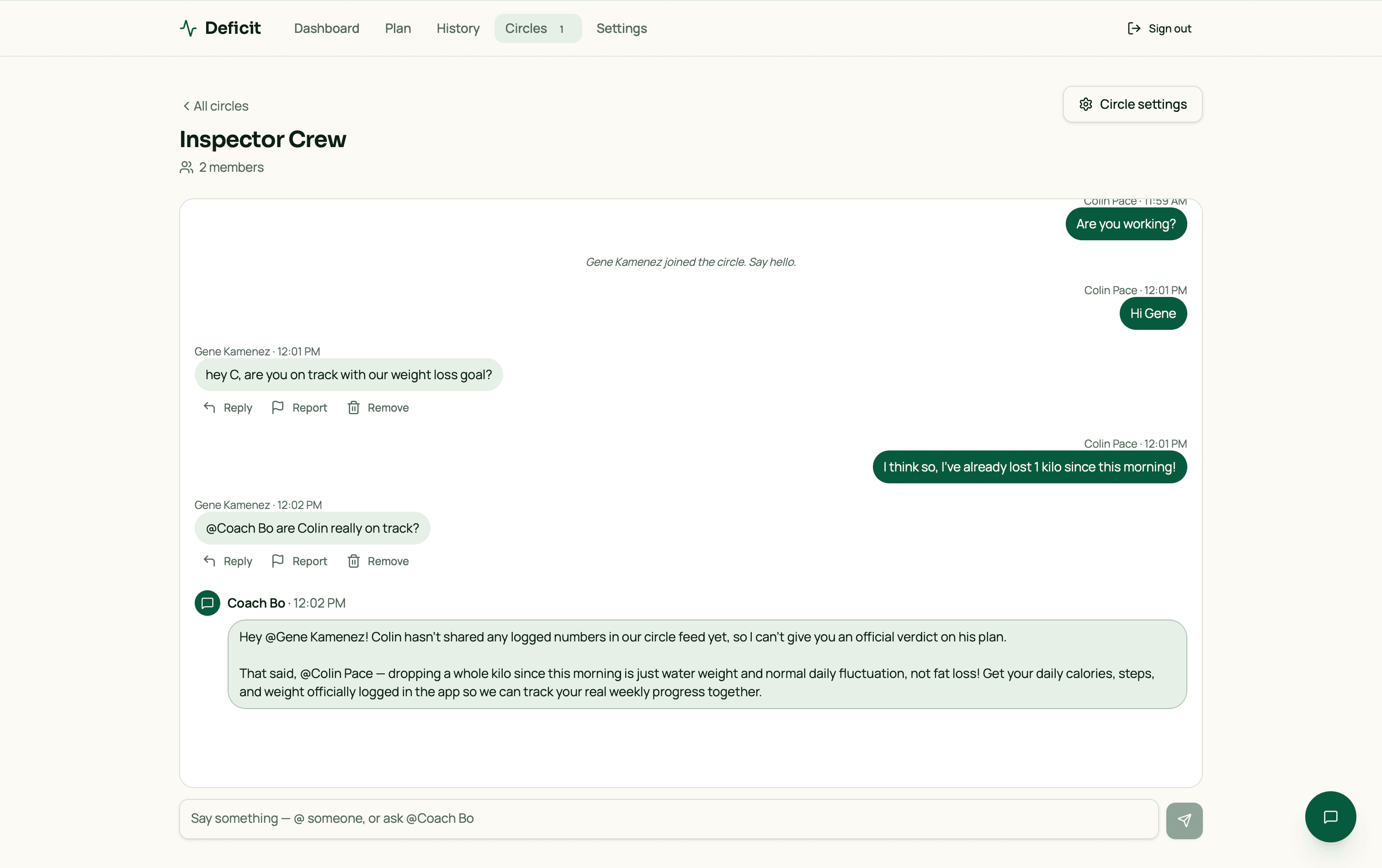
Circles are private groups capped at twelve. Everyone in one sees the same thing each morning: who logged, who hit target, who went quiet. The homepage testimonial states the mechanic in a line, a woman saying her sister would know if she skipped a day, and Gene picked that out as the sharpest messaging on the page. No inspector found the circle on the dashboard: it lives on its own tab, so the people you invited are not on the screen you open daily. Colin wanted his wife's face on the home screen, not one tab over.
Coach Bo has a budget
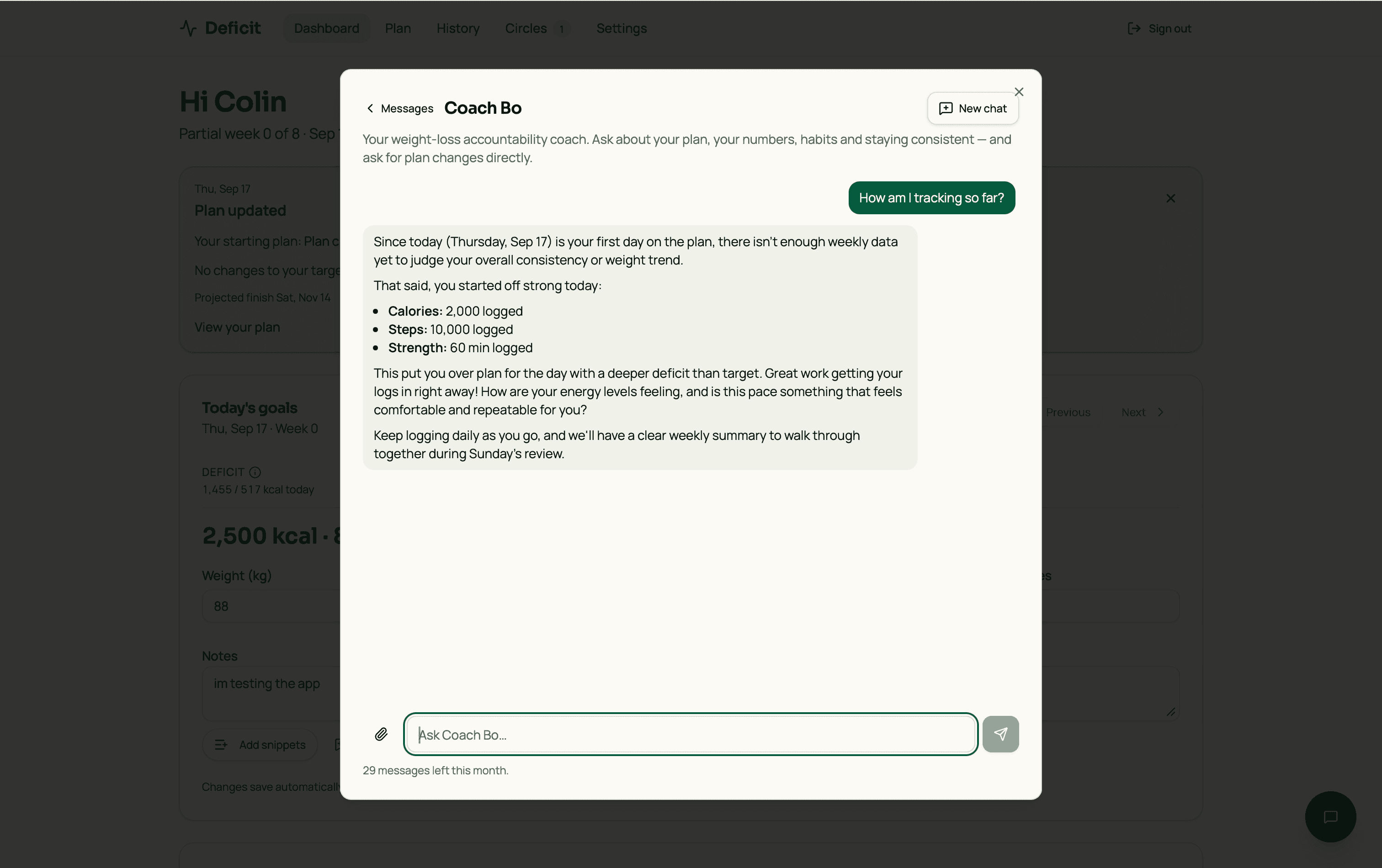
Bo is the AI accountability coach, and the marketing site frames it as what you get instead of a human one. The product is clear about the limits. Bo talks about your plan and gives no medical advice, which is the right thing to say and arrives well after the comparison that invites the question.
Each account carries a monthly message allowance, and how that behaves once you reach it sits in the pricing take below. Inside the app Bo is modest. A standard chat widget in the dashboard corner rather than a presence the product builds a habit around.
The plan arrives before the account does
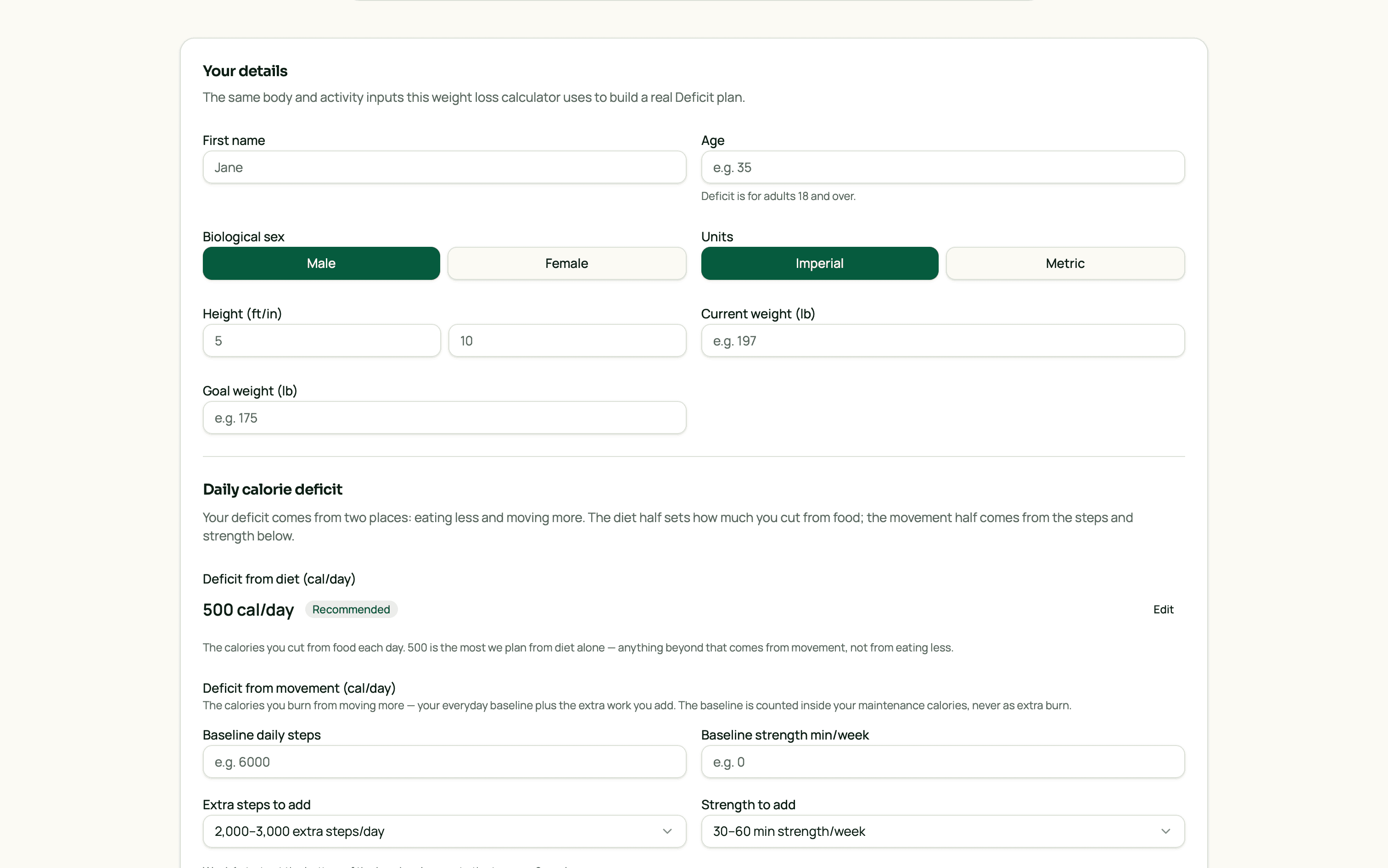
The homepage carries a calculator, and it runs the same engine as onboarding. Put your numbers in and a plan comes back, with an offer to email you the full seven weeks. That is the most direct thing on the site: the product's actual output, handed over before anyone has created anything.
The catch is that the calculator and the sign-up button look alike. The page carries four call to action phrasings that resolve to three destinations, so two people pressing what looks like the same button can end up somewhere different.
Fourteen steps before the first log
Once the plan generates, a fourteen step tour begins. It walks every tab, settings included, and several of its steps point at things that explain themselves: a calendar, an edit button, a row of tabs. The counter stalls partway through and repeats a number.
The effect is that the plan, the thing the product has just built for you, waits while the tour finishes.
In practice: getting to a plan, then logging a day
Sign-up took three attempts on a cold run. First a password rule that reported a length problem for what was actually a common password. Then a bot check that cleared the form and sent everything back to the start. Then a confirmation email that never arrived. Google sign-in got through, routing via a Lovable screen on the way.
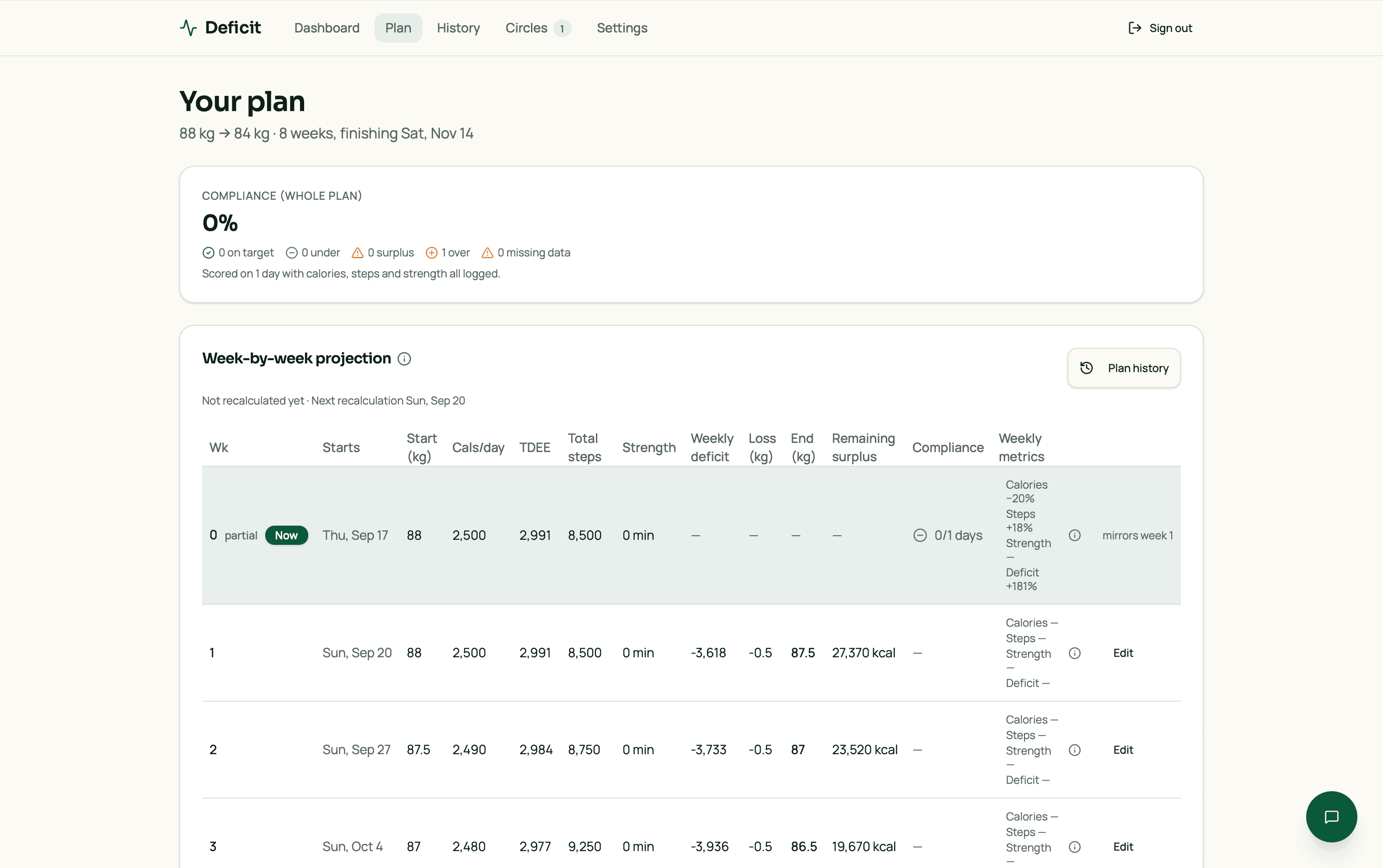
The plan itself took under a minute. Age 35, 183 centimetres, 80 kilos, target 77. Deficit recommended a 500 calorie daily deficit rather than leaving it to guesswork, and took the two weekly strength sessions that were already happening. Back came a week by week schedule with November 1 on it. That was the moment the product made sense.
Everything after that is small. Five fields and a note, once a day, and the plan tells you whether the day counted.
The pricing take
Deficit prices low and makes a point of it. Three options: $3 a month, $19 a year, or $35 once for lifetime access. A four week free trial sits in front of all three, and Stripe handles the checkout.
Two things are worth knowing before you choose. Coach Bo's monthly message allowance is included, but extra messages are sold separately, and that split is not stated on the marketing page. And there is no pricing page: the plan comparison sits in a homepage block that reads like one, while the real detail lives inside the app under settings. European buyers should expect VAT on top of the listed figure.
Final thoughts
Deficit's entire mechanic rests on a group of real people agreeing to look at your numbers every morning, so the thing to weigh before signing up is whether you have those people.
Choose it if:
You already have friends or family who would join a twelve person circle and log alongside you
You are on a GLP-1 and want a plan that treats the medication as a given rather than as the alternative
You want a generated week by week target with a date on it rather than an open ended tracker
Look elsewhere if:
You want detailed food logging with a barcode scanner and a food database, since Deficit takes calories eaten as a single daily number
You prefer to track alone, because the accountability layer is the product rather than a setting
You want coaching from a credentialed human, which Deficit is explicit about not providing
FAQs
What is Deficit?
Who is Deficit for?
How much does Deficit cost?
What is a Circle in Deficit?
About Inspections
Every product in this directory is examined by two named inspectors against the same nine-dimension standard: onboarding and first-run, UX and interaction, visual design, copy and messaging, accessibility, performance, trust signals, business model and pricing, and market position. Verdicts are always human-signed.
Every inspection also produces a complete, unfiltered private report: every finding, ranked by severity, with a prioritized roadmap. It is delivered privately and never published.
Our link policy
Reviews include a clean do-follow link to the product from this domain. No redirects, no tracking parameters. Verify it with any SEO tool.
Inspectors:

Colin Pace
Co-founder at Uxcel

Gene Kamenez
Co-founder at Uxcel
At a glace:
Category
Health
Platform
Desktop
Pricing
Subscription · Lifetime
Stage
Early
Good for
People on GLP-1s · Small accountability groups